Venezuela’s Supreme Court Appoints Delcy Rodríguez as Interim President Amid Political Crisis
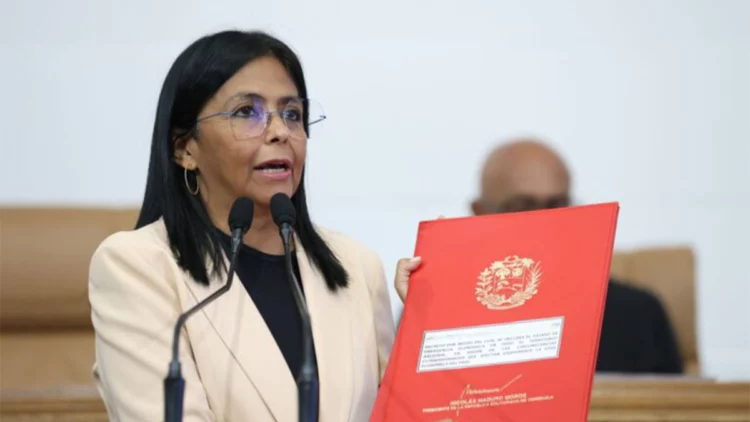
Venezuela’s Supreme Court has taken the extraordinary step of naming Vice President Delcy Rodríguez as the country’s interim president amid a deepening political crisis. The Constitutional Chamber ruled that Rodríguez should take over presidential duties to maintain “administrative continuity” and the defence of the nation following the sudden absence of Nicolás Maduro. This decision aims to keep government functions stable as Venezuela faces intense domestic and international pressure. The court cited constitutional provisions to justify the swift transfer of authority.
The change in leadership followed a dramatic event in Caracas, where President Nicolás Maduro was detained by U.S. forces in a military operation. Maduro and his wife were taken from Venezuela and transported to New York, where he now faces legal proceedings related to long-standing charges brought by U.S. authorities. This unprecedented intervention has stunned global observers and sharply divided international opinion on both legality and consequences. Maduro’s removal from power has created a constitutional vacuum that the Supreme Court says required immediate action.
As interim president, Delcy Rodríguez has assumed all powers and responsibilities of the Venezuelan presidency, though the legal framework for her tenure remains subject to further court deliberation. Her appointment is intended to uphold state functions and defend Venezuelan sovereignty during what the court described as Maduro’s “forced absence.” Rodríguez’s elevation places her at the centre of a rapidly evolving political landscape, with tensions high among domestic institutions and foreign governments. The court continues to debate how long her interim role should last and under what constitutional authority it should operate.
The international reaction has been swift and varied, with many nations condemning the U.S. operation that led to Maduro’s capture and questioning the legitimacy of the leadership shift. Protests and diplomatic rebukes have emerged from governments that view the intervention as a violation of international law and Venezuelan sovereignty. Others have called for political dialogue and a peaceful resolution to avoid further destabilisation. Within Venezuela, divisions persist among political factions, security forces and the general public over the country’s future direction.
Rodríguez, long a key figure in Maduro’s government, now faces the complex task of steering Venezuela through this crisis while managing internal dissent and external pressures. Her leadership will be closely watched as the nation grapples with economic challenges, diplomatic fallout, and urgent calls for democratic processes. The transition marks one of the most significant shifts in Venezuelan politics in years, underscoring deep fractures within the state and its relations with global powers. The world remains alert to further developments as Venezuela seeks stability amid uncertainty.