Petrol Leads Nigeria’s Imports with Over 613 Million Litres in One Year
Fresh data from the Nigerian Midstream and Downstream Petroleum Regulatory Authority (NMDPRA) has revealed that Nigeria consumed 613.62 million litres of petrol between October 2024 and October 10, 2025, despite ongoing efforts to boost domestic refining.
According to the figures obtained by The Punch, imported petrol accounted for the majority of Nigeria’s fuel supply during this period, showing that the country still heavily relies on foreign products to meet local demand. Out of the total petrol consumed, 377.54 million litres were imported, while 236.08 million litres were produced by local refineries such as the Dangote Petroleum Refinery.
This means imports made up about 63 per cent of the total petrol used in the country, while local production contributed 37 per cent, marking a gradual improvement compared to previous years. The NMDPRA report showed that local refining output rose significantly—from 9.62 million litres per day in October 2024 to 18.93 million litres per day in October 2025, nearly doubling within one year.
In contrast, import volumes dropped sharply from 46.38 million litres per day in October 2024 to 15.11 million litres per day in October 2025, a 67 per cent reduction. The monthly breakdown reflected a steady decline in imports as local refineries ramped up output. While import figures fluctuated slightly between November 2024 and May 2025, they fell consistently afterward, signaling a gradual shift toward self-sufficiency.
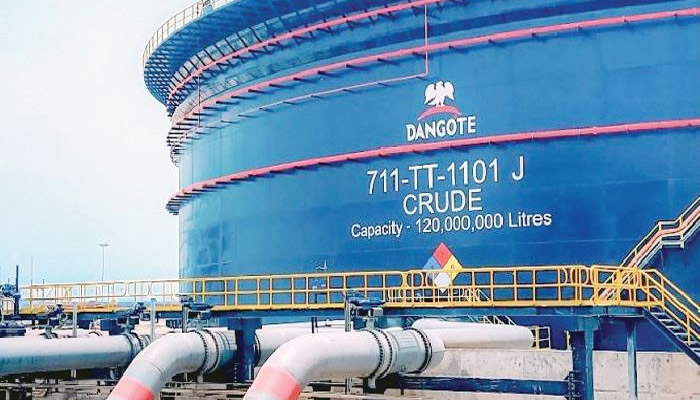
Domestic refining, led by the 650,000-barrel-per-day Dangote Refinery, has played a major role in this transformation. From just under 10 million litres daily in late 2024, local output grew to more than 20 million litres per day by early 2025, demonstrating the refinery’s impact on the nation’s energy stability. Although there were occasional dips due to maintenance and logistics, the overall increase marked a historic turnaround in Nigeria’s refining performance.
The report also indicated that the total petrol supply averaged 46.6 million litres per day, comprising 29.5 million litres from imports and 17.1 million litres from domestic refineries. Analysts note that this improvement has reduced pressure on Nigeria’s foreign reserves, as less foreign exchange is now needed to pay for imported fuel.
Oil experts say the progress coincides with the first full operational year of the Dangote Refinery, which began large-scale production earlier in 2025. Since its commissioning, the refinery has supplied between 15 and 20 million litres of petrol daily, helping to reshape the country’s energy landscape and reduce dependence on imports.
However, the CEO of Petroleum.ng, Olatide Jeremiah, stressed that while the improvement is commendable, local refineries still face major challenges. He explained that the Dangote Refinery and others need uninterrupted access to crude oil in naira to further scale up production and drive down fuel prices. He added that it was “unacceptable” for Africa’s largest oil producer and host to its biggest refinery to still import 60 per cent of its daily petrol needs.
Jeremiah urged the Federal Government and the Nigerian Upstream Petroleum Regulatory Commission (NUPRC) to implement stronger policies ensuring local refiners have full access to domestic crude. According to him, “Nigeria, the biggest producer of crude in Africa with the biggest refinery in Africa, should not be importing about 60 per cent of its daily fuel consumption. The government must create frameworks that guarantee full local access to crude if we want cheaper fuel prices and true energy independence.”
Despite ongoing challenges, experts agree that the growth in local production marks a positive step toward reducing fuel importation, strengthening the naira, and improving Nigeria’s long-term energy security.